Agentic AI isn't just the new kid on the block.
These agents are working alongside advertisers everywhere.
From lead gen to media buying, marketers are adopting a more hands-off approach, letting agents do the heavy lifting of execution while they own the strategies and briefs those agents run on. The agentic AI market is currently worth $9.9 billion and is growing more than 40% per year.
That said, if you plan on adopting more agentic workflows, you should talk the talk. Because understanding the lingo and concepts that explain how agents function will help you make better decisions in choosing and setting up your own agents.
This post will do just that by defining the acronyms, concepts, and terms in the agentic AI world.
Google's open protocol for AI agents interacting with other agents, as distinct from agents interacting with tools.
Why it Matters
Transport determines reach: an agent speaking A2A can negotiate with any seller agent that speaks it, while one built on proprietary messaging is limited to that vendor's partners. Because those negotiations happen at machine speed, your guardrails have to be set before an agent goes live rather than caught in a plan review afterward.
An umbrella framework created by IAB Tech Lab for agentic standards. Named by CEO Anthony Katsur, AAMP is built upon three pillars: foundations, protocols, and trust/transparency.
Why it Matters
Behind every contract is a person who approves spend and takes responsibility if something goes wrong. Agentic buying bypasses them, and AAMP (especially its trust/transparency pillar) is serving as a replacement for that human verification layer.
Optimizing your brand's presence so an autonomous agent chooses it when acting without human supervision.
Why it Matters
Agents are entering the consideration stage where most brands do their heaviest work, and there's no page for them to render. They have to determine who you are, what you offer, what it costs, and whether it's available. That makes entity consistency, product schema, and AI-readable pricing crucial for brands to get right.
The checkout-execution layer of agentic commerce, co-created by OpenAI, Meta, and Stripe. It defines how agents collect a buyer's payment selection, passes a scoped token to the merchant, and then allows the merchant to charge it through any compliant processor while remaining the merchant of record.
Why it Matters
Standards for agentic commerce are advancing faster than consumers' willingness to use them. ACP governs the checkout layer, which makes it the relevant standard for any party selling directly.
An open standard allowing AI agents to discover inventory, negotiate terms, execute media buys, and receive delivery data across multiple platforms. It was built upon A2A and MCP and is governed by AgenticAdvertising.org.
Why it Matters
If this gains steam, you can compare and purchase inventory across platforms through one standard. That reduces platform lock-in while strengthening your negotiating power with DSPs.
A neutral framework that lets you verify which agent is which, who runs it, and what authorizations it has.
Why it Matters
Agents can make their own decisions, and if those decisions turn out to be wrong or harmful, you need an accountability trail. A registry provides one by recording which agent performed which task and what it was authorized to do.
The rebranding of existing chatbots, templated workflows, or robotic processes as AI agents without changing the underlying architecture. It's essentially putting a wrapper on an existing product or system.
Why it Matters
Ideally, you want to buy or build an agent customized to your business and marketing objectives, not a repackaged AI product. One way to verify you're getting something real is by asking for a decision log from a live account to show the system changing its own plan.
An ad format where transactions complete inside the ad experience itself. There are no clicks, landing pages, or separate checkout carts.
Why it Matters
With no click analytics, funnel reports, or path analysis, your only controls are the offer, product data, and copy. It also requires a strategic realignment, because agentic ads are best reserved for simple repeat purchases.
The authorization and trust layer built for agentic payments. Initiated by Google, it uses cryptographically signed mandates to provide proof of who authorized a payment, with the ultimate purpose of providing transparency for high-risk transactions.
Why it Matters
If an agent buys on a client's behalf and they dispute it, AP2 gives you a record of proof. This is crucial for scenarios where regulatory rules come into play, and where agents deviate from set instructions.

Buyer agents represent advertisers, reading a brief, discovering inventory, negotiating buys, and making purchases. Seller agents represent the publisher or platform, exposing available products, pricing, and formats before responding to offers.
Why it Matters
Being specific about outcomes, limits, and exclusions is important when dealing with agents, especially ones that buy media on your behalf. Precise briefs and strong guardrails steer agents to make decisions that reflect your strategy and brand.
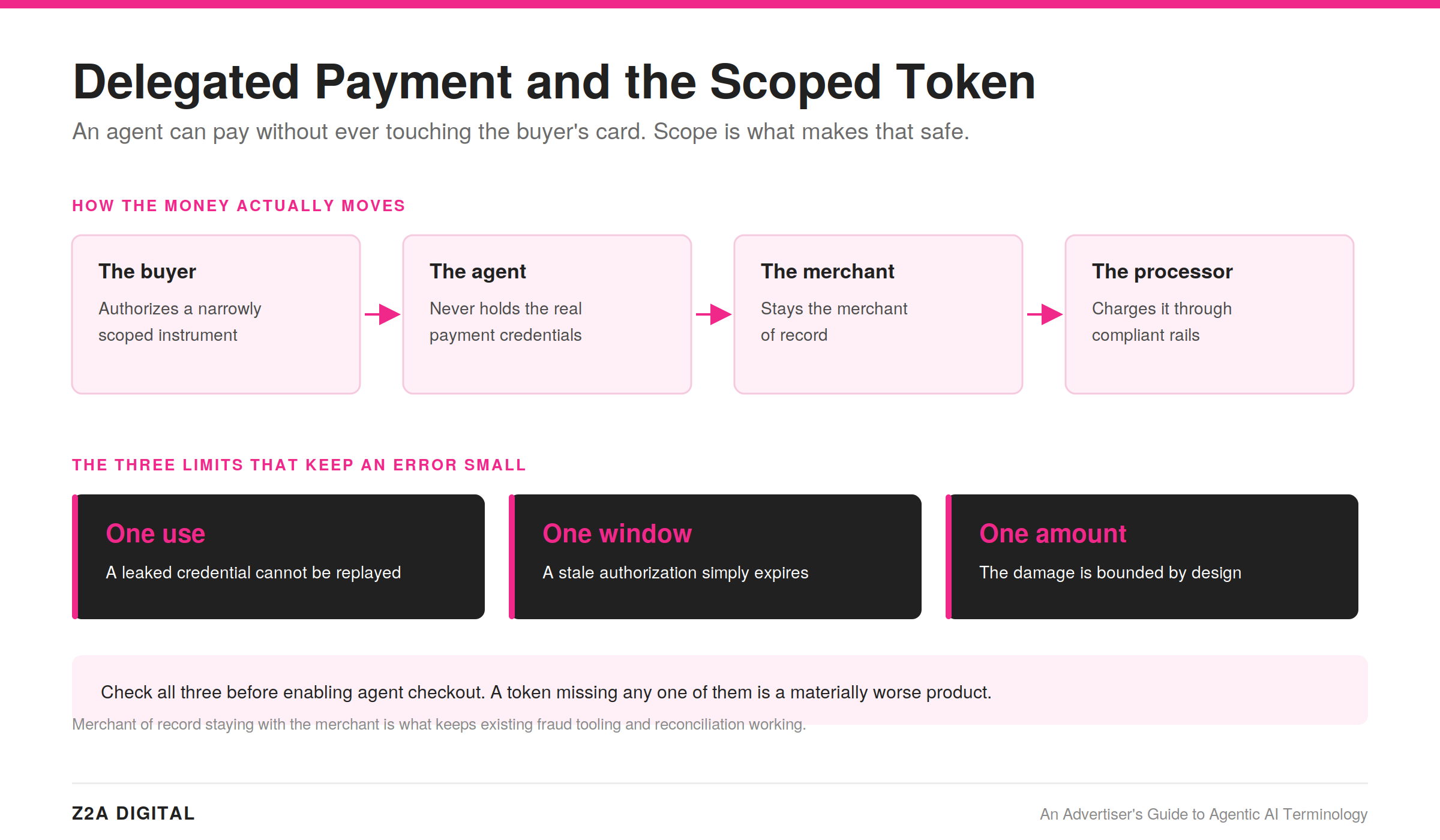
The mechanism that allows AI agents to pay on a user's behalf without ever holding the user's payment credentials. The user authorizes a narrowly scoped instrument and passes it to the merchant, which then runs it through a compliant processor while remaining the merchant of record.
Why it Matters
Software that gets payment authority needs boundaries established before the first transaction instead of after it. That usually entails three constraints: a spending cap, a time window, and a stated purpose, which in combination produce a record that teams can audit afterwards. Ultimately, this preserves your merchant of record status, keeping fraud detection and reconciliation processes intact.
A Markdown file at your domain root listing the specific pages an LLM should read.
Why it Matters
Adoption is limited and the major providers haven't committed to it. Google's AI optimization guidance states that no new machine-readable files or Markdown are needed to appear in Search, including its generative features, and server-log studies show AI crawlers rarely request the file. Publishing one takes little effort and does no harm, but it's not a substitute for schema completeness and content structure, and it isn't worth paying for as a standalone program.
Originally from Anthropic, an open standard for how AI applications connect to external tools and data sources.
Why it Matters
MCPs are vital connectors for AI tools, especially in agentic workflows, providing a shared open standard along with dynamic tool discovery and secure execution layers. It's also worth asking whether a vendor connects over MCP or something proprietary, because standards-based integrations carry over when you switch tools and proprietary ones don't.
Although it's a computer science concept, in an agentic AI context non-determinism refers to identical inputs that don't always produce identical outputs. This makes single-run measurements unreliable, and you must measure AI visibility with aggregate signals such as mention rates, citation rates, and answer positions.
Why it Matters
Checking your brand's presence once tells you almost nothing, because the same prompt can return a different set of brands on the next run. Report how often you appear across many runs as a percentage, and keep your prompts narrow, since broad categories are far less stable than specific ones. It's also the reason to be skeptical of any tool selling you a fixed "rank" in AI results.
AI agents that are built into existing advertising platforms, allowing advertisers to automate buys. Examples of this include Google's Performance Max (PMax) and Meta's Advantage+.
Why it Matters
Platform-native agents have their own set of advantages and disadvantages depending on your goals and desired level of control. Before committing, check which decisions the platform now makes on its own versus which ones it still surfaces for your approval, since that difference determines how much control you're actually handing over.

An information-retrieval method where one user question becomes multiple simultaneous sub-queries spread across subtopics and data sources, with results synthesized into a single answer.
Why it Matters
Query fan-out supports deeper reasoning and changes how agentic systems retrieve data, pulling evidence from several sources rather than one ranked page. Because answers get grounded in multiple retrieved passages, the approach also helps limit hallucinations, and it means your content competes across a topic's sub-questions instead of a single phrase.
A single-use, time-bound, amount-limited credential that allows an agent to complete purchases without holding the buyer's payment details. This is the mechanism that ACP uses.
Why it Matters
Advertisers should check that an agent checkout they enable limits tokens to a single use, one time window, and one amount. Those limits ground the agent so that its error risk remains minimal.
A schema (created by LiveRamp, now called Agentic Audiences) for how agents exchange identity, contextual, and reinforcement signals.
Why it Matters
UCP matters because it allows AI agents to exchange real-time consumer intent, privacy-safe identity, and behavioral signals through vector embeddings rather than slower, heavier text-based exchanges. That speed is what makes agent-to-agent signal exchange viable inside real-time bidding.

Targeting by mathematical proximity instead of keyword or audience segmentation. Customer data is converted into a numeric sequence in a file a supply-side model can interpret. It functions as a more advanced form of lookalike targeting.
Why it Matters
Vector-based targeting carries semantic meaning rather than keywords, which allows for more flexibility in understanding users, content, and intent. It also offers greater precision than traditional broad segmentation. The agentic connection is that it lets an agent interpret an audience without being handed a segment definition, which is what makes the targeting flexible and also what removes your ability to state exactly who you targeted.
Coinbase's protocol for instant stablecoin transactions over HTTP, reviving the defunct 402 status code. It's built for machine-to-machine microtransactions and per-request access to APIs and data.
Why it Matters
Publishers may start charging agents per request rather than blocking them. That could put some of the content your brand relies on behind a paywall, and could change pricing on the data you license.
Just as traditional dictionaries get updated with new words every year, the agentic AI lexicon will continue to grow. Fast. As agents become more sophisticated and gain power, there will be new developments and entries to follow. We'll be here to add more of those definitions and terms to this page, so that you're up to speed on all things agents.
Ready to talk about how agentic AI can supercharge your user acquisition efforts, media buying, and more? Get in touch with us to learn how.

.png)

%20(3).webp)