Ad fraud is growing and evolving faster than the industry can keep up with. With AI and bot traffic driving most today’s fraud, advertisers need to have a strategy in place to detect fraud by understanding natural attribution windows and patterns. Once established, advertisers can use these metrics and the appropriate tool stacks to reject fake clicks and installs.
Ad fraud continues to be a thorn in advertisers' sides.
And even with all the bot blockers and third-party platforms out there, the scourge is spreading fast and far.
In 2026, the daily average of blocked AI-related bot incidents skyrocketed 12.5x year-over-year, jumping from 2 million to 25 million. And with so much traffic now coming from bots, the issue is likely going to compound.
So your team needs to have a defense in place. In this post, we'll provide some tips on how to detect and filter sophisticated mobile ad fraud, so you can get a true and accurate picture of your ad performance.
The backbone metric for detecting most mobile ad fraud is click-to-install time (CTIT). Over 85% of legitimate installs occur within an hour after a click, with a lengthy tail extending beyond the first 24 hours.
However, fraudulent traffic breaks the pattern, either by clustering unrealistically fast (a.k.a. click injection) or spreading out clicks evenly across a full attribution window with no correlation to the actual click (click spam).
Generally speaking, if more than 40% of installs from one sub-publisher show a CTIT under 10 seconds, you're seeing click injection. And if you're seeing installs spread evenly across the window with no clear relationship to the click at all, you're likely looking at click spam.
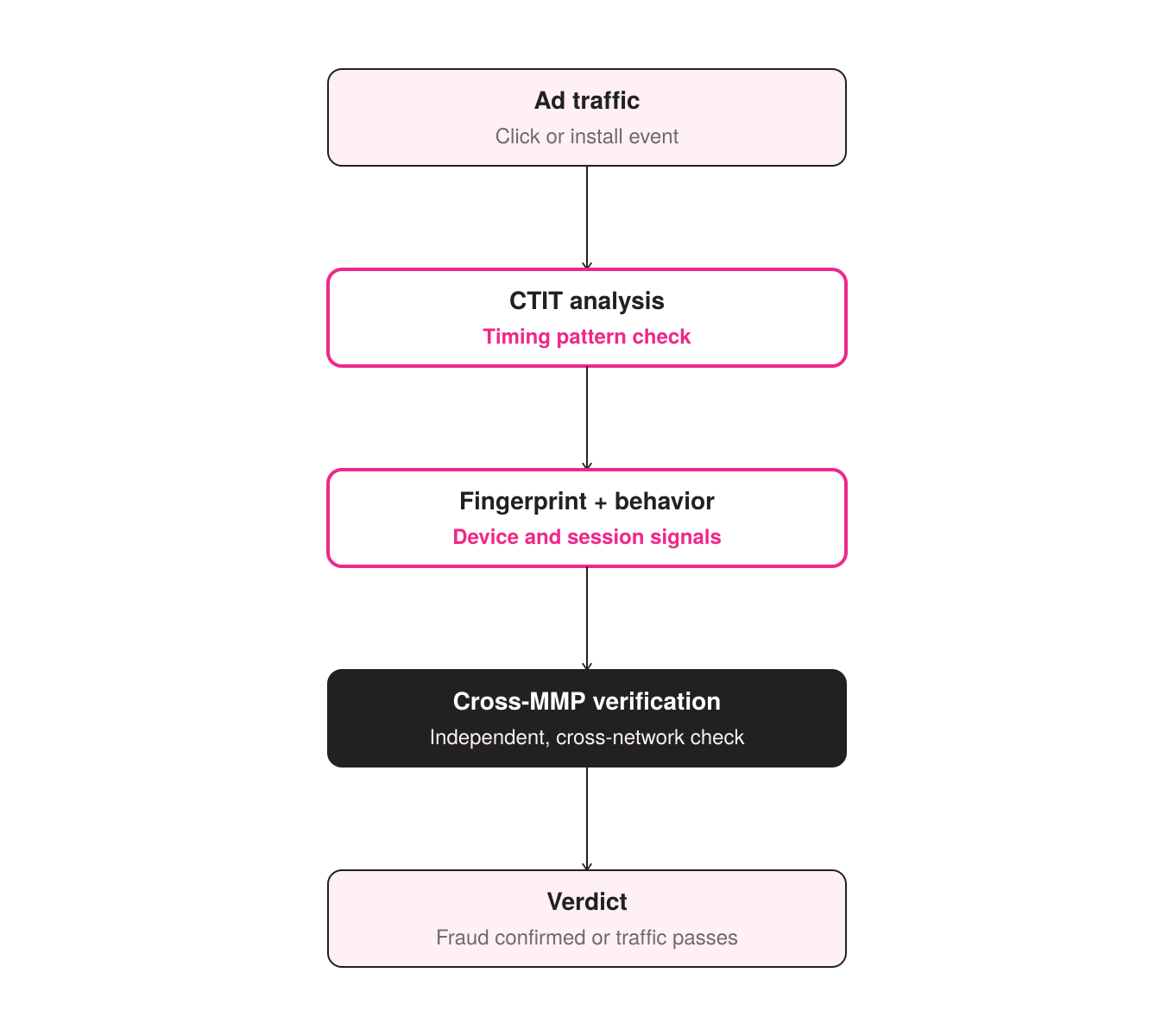
Fingerprinting works by building an identifier (probabilistic in nature) from browser, OS, font, canvas, WebGL, and network signals, which then catches the devices generating repeated fraudulent clicks under separate disguises. It serves as the backbone of deduplication for both the prevention of click fraud and detection of fake installs.
That said, device farms have evolved beyond emulators and now often run on real, rooted, or jailbroken mobile hardware, typically paired with residential proxies that route traffic through real IP addresses used by household devices. This is where fingerprinting can break down; it can't catch this type of fraud alone and needs to run alongside behavioral and network-level signals.

Behavioral signals expose when session-level activity isn't human — including interaction timing, tap/scroll cadence, and movement through onboarding. The reason for this is that even highly advanced bots struggle to replicate the long tail of a real user journey.
That said, bots have surpassed simple taps. They can now imitate onboarding swipes, session starts, and in-app events such as adding items to carts. Advancing AI models will get better at this, and the heuristics used to catch this behavior may eventually lag behind the increasing capacity of these bots. But at the moment, you can measure for unusual activity (metrics mentioned above) outside the usual attribution window to detect potential ad fraud.
Yes, MMPs can miss fraudulent installs completely since they can only see their own attribution graphs. That allows cross-MMP collusion, where two networks claim credit for the same install, or fraud modeled to mimic your CTIT curve to slip through unnoticed. So relying on just one can introduce some major blind spots.
There's no singular fix for this issue, but you can combine a few methods to catch fake installs that MMPs miss. That may include:
These methods are not guaranteed failsafes against ad fraud, but they do increase the chances of catching fraudulent activity that MMPs can't detect.
Ad fraud typically hides during pre-bid scenarios, namely programmatic and SSP auctions. The problem with that is many fraud detection methods operate post-bid, meaning they evaluate traffic after spend has already been committed to an install, or after a click has been recorded.
The solution to this usually requires the following:
These methods are heavily dependent on changing media-buying practices, not just toggling dashboards, which is another reason why fraud often slips through.
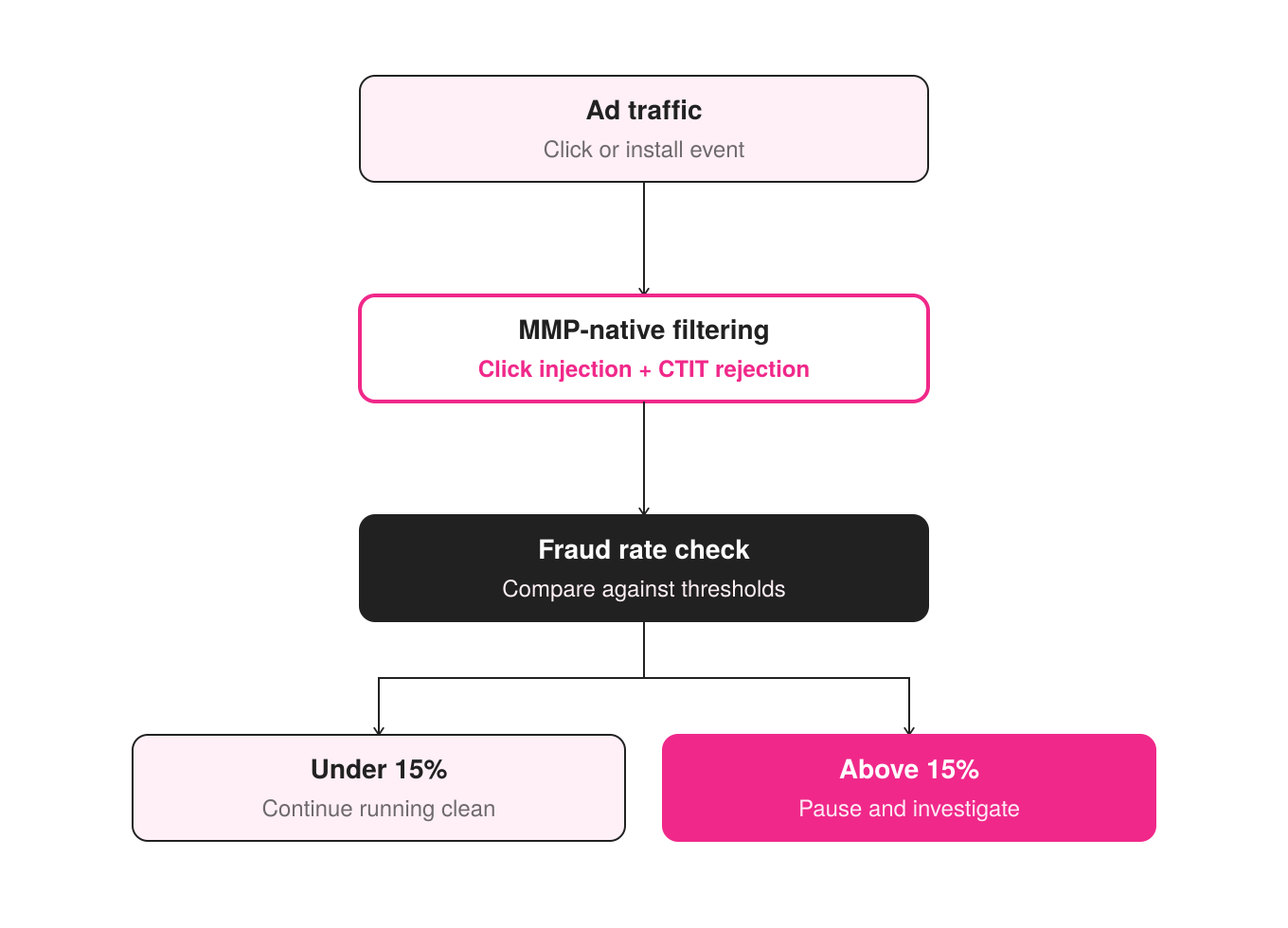
MMP-native suites such as AppsFlyer (Protect360), Adjust (Fraud Prevention Suite), and Singular (Fraud Prevention) all provide a layer that advertisers can rely on. They all offer real-time blocking, which stops fraud in its tracks before it corrupts reported data. They also provide post-attribution detection, which catches sophisticated fraud that may slip through the initial screen. As spend increases, it becomes worth adding independent verification tools on top of MMPs so teams aren't reliant on a single vendor.
Two mechanisms do the heavy lifting here: click injection filtering and CTIT outlier rejection. Click injection filtering compares click timestamps against install-start and install-finish markers pulled from the platform's own referrer API, rejecting any click that lands after the install already began.
Additionally, CTIT outlier rejection happens at the distribution level. Installs with suspicious timing patterns get reattributed to organic credit or dropped altogether. This prevents advertisers from paying a sub-publisher for traffic that shouldn't have received any credit to begin with.
Baselines vary by traffic. However, a general framework that works across the board is this:
Again, these are general benchmarks, not hard rules — treat them case by case.
No. Trying to filter out fraud completely is simply unrealistic, because fraud detection usually carries some false positives. Chasing down that last 2-3% introduces a cost that surpasses the cost of just absorbing it. Strategic filtering is about preventing diminishing returns, not eliminating completely, as this leads to an unsustainable use of resources.
According to Branch's 2026 survey of 455 marketing executives, the average team loses 27% of their paid digital budget to ad fraud annually — roughly $3 million for the typical enterprise surveyed. That said, this stat likely reflects teams that are estimating rather than actually measuring.
And in that lies the lesson: don't guess — measure your fraud rate first. Pull raw fraud data from your MMP or verification vendor before committing to a budget based on an estimate. Also, pause a traffic source that exceeds 15% fraud rather than allowing it to continue running just because it converts.
One thing to keep in mind with detecting and filtering ad fraud is that it's not a one-time setup or activity. You're dealing with a moving target, and the fraud happening today is designed to resemble the tools you currently trust.
That said, sophisticated fraud studies and matches the normalcy set by your existing attribution, and it can't be toppled by one-off solutions — which is why you need to treat it as an ongoing battle. But the right combination of tools, protocols, and frameworks makes it a manageable one, so you're fighting it head-on, not retroactively.
Ready to think differently about ad fraud detection and filtering? Talk to us today.
Mobile fraud is more difficult to catch because attribution is dependent on probabilistic device matching rather than deterministic cookie tracking, allowing fraudsters to inject fake clicks with more ease. Web fraud is easier to detect because you can examine full session data — page visits, time on site, JavaScript execution. Mobile fraud, by contrast, often only surfaces once you dig into post-install retention, since the initial attribution event itself looks legitimate.
Yes, it can. AI-powered fraud detection is becoming a standard approach since it can spot unusual patterns as they unfold, allowing marketers to block fake traffic before it contaminates campaign data. That said, fraudsters are also using AI to create more convincing fake activity, which can deceive AI into believing that an action was human generated.
Two common signs are unnaturally short click-to-install time (CTIT) and an unanticipated rise in new device installs. A third sign is unusual post-install behavior, such as a user converting once but never opening the app again, since real users typically show some continued engagement after a purchase.

.png)



%20(3).webp)