Ad waste might seem like a cost of doing business, an inevitable expense.
While completely eliminating ad waste is unrealistic, CMOs and marketing teams are tolerating too much of it.
And the numbers reflect it.
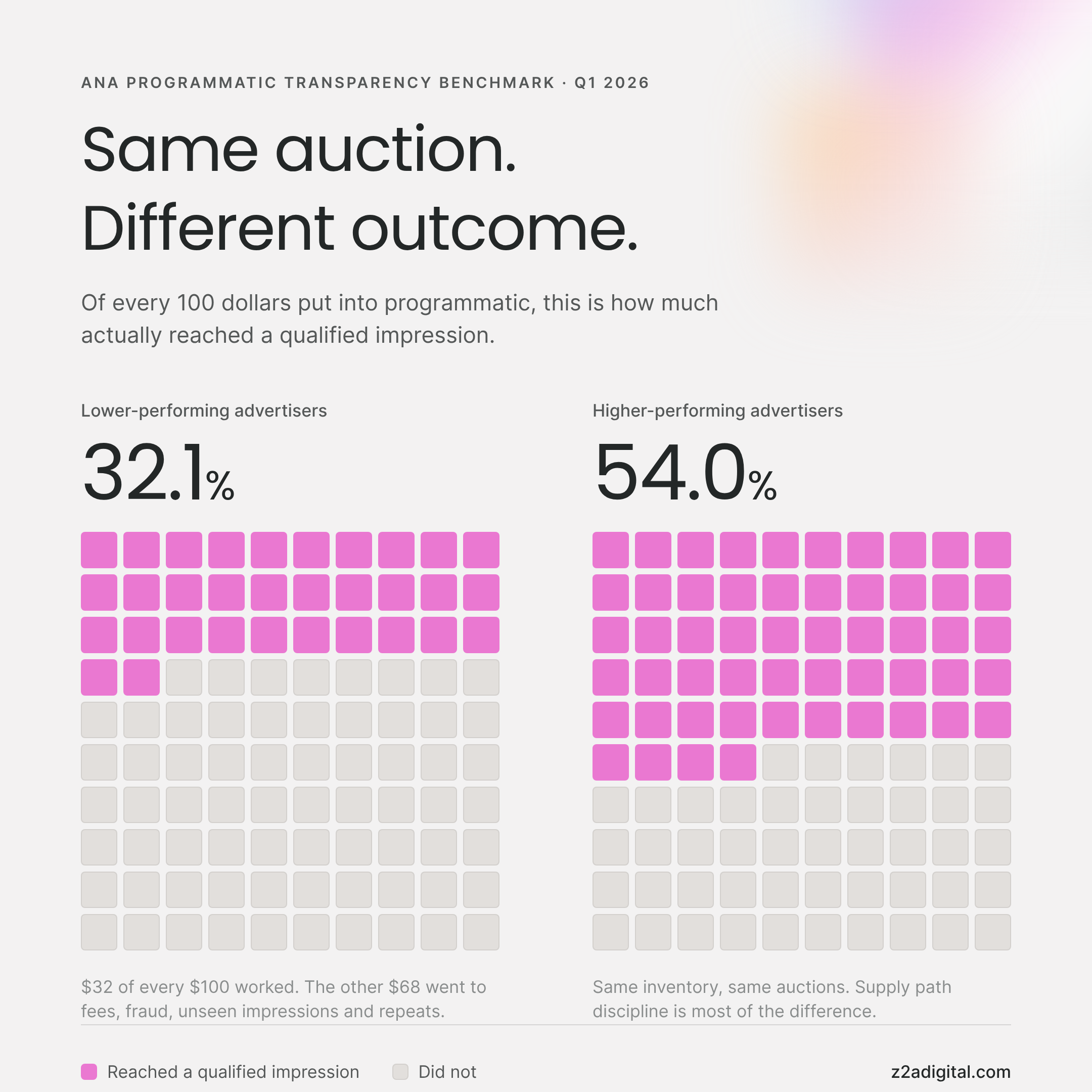
For example, Gartner's 2026 CMO Spend Survey of 401 CMOs found that CMO confidence in delivering ROI fell to 43% this year, down from 56% in 2025 — the steepest year-over-year drop in any confidence measure the survey tracks. Marketers themselves put a figure on the leakage: in DemandScience's 2026 State of Performance Marketing report, 750 senior marketing leaders reported that an average of 25% of marketing budget is wasted on efforts that fail to drive outcomes. And the ANA's Q1 2026 Programmatic Transparency Benchmark found that lower-performing advertisers converted just 32.1% of their programmatic spend into qualified impressions, against 54.0% for higher performers.
But with better budgeting decisions, marketers can slash waste considerably. In this post, we'll explain how to reduce wasted ad spend, along with how to spot budget leaks in the first place and plug them for less waste in the future.
Wasted ad spend always has a cause. And for you to minimize current and future ad waste, you have to know what's causing your dollars to leak in the first place. Only then can you put a stop to it. Fortunately, wasted ad spend has many known (and fixable) causes.
Other factors, such as excessive frequency, non-viewable impressions, and made-for-advertising (MFA) placements, can also lead to wasted ad spend, but the ones listed above are some key drivers. That said, finding these issues and targeting them at the source is the key to reducing wasted ad dollars.
When marketers identify waste, they might reflexively cut ad spend. But that doesn't solve the underlying issue. Aside from seeking the cause(s) (such as those mentioned above), you're better off making your ad campaign work harder so it generates a stronger ROI.
This particular principle ties to the point of poor ad quality mentioned in the previous section. Some ad campaigns are strategically—and, by extension, creatively—"weak," and underperform as a result. Reworking them can make the ads stronger and more effective for your given audience.
Choosing the right creative angle, positioning, and messaging before building assets ensures that every ad variation serves your intent and objectives. By extension, strengthening these elements will lead to more resonant copy, including headlines, V.O. lines, calls to action (CTAs), and other phrasing.
You also need to ensure your hooks are present early (usually in the first 1–3 seconds) and contain an attention-grabbing element such as a compelling visual or a thought-provoking question. The stronger your hook is, the better your completion rates will be and the more likely your audience will convert. Ultimately, creative that performs better delivers better on ROI (and wastes fewer dollars).
If you're wondering how to reduce wasted ad spend, then make sure to lean into contextual ads.
Contextual advertising is all about placing ads in environments that are relevant to a user and are natural fits within a web page's content. For instance, an ad for a fitness app might appear on a sports or wellness blog. With these ads, you reach audiences who are more likely to show an interest in your products based on the content they're consuming, even if they're not searching for your product directly. This alone extends your reach.
In a neuroanalytic study run by GumGum with SPARK Neuro, the ads with the highest contextual relevance drove 43% more neural engagement and 2.2 times better ad recall than less relevant placements. Again, the strength of this performance comes from contextual ads targeting content, not users themselves (protecting privacy, which we'll discuss later).
It's also important to build efficiency into your supply path. A well-optimized supply path helps you structure campaigns so they achieve higher ROI without increasing budgets. Supply Path Optimization (SPO) makes this possible, and when you implement it properly, it helps reduce wasted ad spend by eliminating inefficiencies such as duplicate auctions, redundant bids, and hidden fees.
To get more out of your overall marketing budget, you should factor in where you can make cost savings around infrastructure. Many marketers rely on solutions such as hyperscale cloud providers, which can be useful but can often result in paying premium costs and an obligation to lock into these services.
Changing your infrastructure provider might seem like a hassle at first. But finding an alternative can help you find more cost-efficient providers that can help you reduce spend on baseline computing requirements.
Bespoke hosting providers delivering infrastructure-as-a-service can offer more predictable pricing, clearer billing, and more direct support than hyperscaler contracts.
Once you've established your target parameters, you can make your ad spend do more by spreading it across the appropriate channels, platforms, and formats. It's crucial to avoid being too generic, and budget allocation shouldn't come at the expense of precise targeting. You still need to be focused in terms of which audience you want to reach and where you want to reach them. However, since customers seldom dwell on just one platform, cross-platform strategies are essential.
One practical way to start is to identify which platforms are bringing you the most organic reach. Once you've identified them, you need to divert some spend towards repurposing your best-performing content into adjacent formats. That could mean paid ads, social media ads, video ads, audio ads, or in-game ads. You can also try additional formats such as programmatic display, retail media, CTV, and OTT channels, which can broaden your reach and increase your frequency.
CTV ads let you reach audiences in premium, full-screen (and sound-on) environments where completion rates average around 95%, according to Innovid's benchmarks — though much of that owes to CTV inventory being non-skippable. Retail media, on the other hand, allows you to push users closer to the point of purchase using first-party data supplied by retailers.
Programmatic brings them all together, letting you optimize in real time and consistently target audiences across multiple channels at scale. When you integrate these channels into a unified stack, you can follow your audiences more accurately and minimize wasted ad impressions (and dollars).
Automation offers more than convenience; it boosts performance, which, of course, can reduce wasted spend as well. Automated ad platforms such as demand-side platforms (DSPs), ad attribution products, and anomaly detection services contain features that can help you optimize ad spend, track value KPIs, and flag anomalies present in campaign data.
These tools usually deliver rule-based optimizations such as pausing underperforming ad assets, reallocating budget based on predetermined thresholds, or scheduling campaigns based on historical performance data.
Your team should lean into these tools because they run in the background, surfacing anomalies and even making adjustments before those anomalies can negatively impact spend. And remember, too, that you can automate various aspects of your creative production as well to improve performance and cut down on ad waste. That includes dynamically testing and optimizing your copy, visuals, and formats, and identifying winning combinations faster than manual split testing or hands-on workflows.

Privacy-first advertising is a key and perhaps overlooked answer to how to reduce wasted ad spend. This approach improves your data quality, helping you make better buyer decisions. Third-party data and cross-site tracking are fading away, making identity-centric targeting more reliant on degraded or obscure signals, which can lead to misattribution or duplicated reach.
Privacy-first strategies optimize around first-party, consented data, which is more accurate and stable to begin with. That allows you to allocate ad spend with more confidence and avoid spending on impressions that you can't properly measure against outcomes.
Additionally, privacy-first optimization moves away from user-level surveillance, shifting toward aggregate performance signals and outcome-based learning, which can supply AI systems with the training they need to optimize at scale. For instance, an ad platform can use the training to optimize bids towards top-performing cohorts based on their buying patterns without having to look into their histories.
Rather than chasing individual users, privacy-first AI models analyze conversion, engagement, and contextual patterns to predict where ad spend will be most efficient. The result here is twofold: the users' privacy remains protected, and the optimization around more precise targeting pools allows you to cut wasted ad spend. And your advertising will perform better as time moves on, while the budget is shifted towards impressions that are more likely to drive results.
In this shaky economy, ad budgets are among the first to be scrutinized and cut. But eliminating budgets altogether isn't always the best solution, however tempting it is to hit the panic button. When you're wondering how to reduce wasted ad spend, remember that slashing a budget altogether doesn't remove the underlying causes of waste.
And remember too that prematurely cutting a budget can undermine opportunities for growth as well. With the right combination of stronger creative, sharper allocation, automation, privacy-first strategies, and supply path optimization, you can see to it that your budget fuels performance instead of disappearing or fueling waste.
Ready to think differently about how to reduce wasted ad spend? Talk to us today.
In the context of mobile advertising, wasted spend can refer to any money or budget spent in vain that yields no results or fails to generate ROI. Additionally, wasted ad spend could have been avoided if infrastructure, data, automation, and overall strategy were designed to detect wasteful conditions and prevent them from leading to wasted dollars.
You can calculate ad spend by adding up the total amount of money paid for ad placements over the course of a specific ad campaign, channel, or time period. Alternatively, you can multiply action volumes by their unit costs using specific ROI calculators.
Although it varies depending on industry, commonly cited cross-industry benchmarks put the average return on ad spend (ROAS) somewhere between roughly 2:1 and 4:1. That means brands earn around $2.00 to $4.00 in revenue for every $1.00 spent on advertising.

.png)



%20(3).webp)