In 2022, EcoBio Boutique, an Italian cosmetics brand faced a dilemma. Despite boasting a vibrant business in Italy, their launch to new markets gave rise to inconsistent, unreliable data.
As Giacomo, one half of the founder duo behind the brand said: “One day it’s good, one day it’s not good”.
But when they implemented multi-touch attribution (MTA), they were able to clearly visualize the customer journeys of their new markets and inform their strategy going forward.
Long story short, they achieved stellar outcomes such as a 55% increase in YoY blended ROAS and a 311% jump in YoY profit.
However, these gains aren’t automatic. Multi-touch attribution only leads to profitable, revenue-driving strategic insights when it’s implemented correctly.
This guide will shed light on how to implement MTA so your data accurately leads you to better strategic decisions.
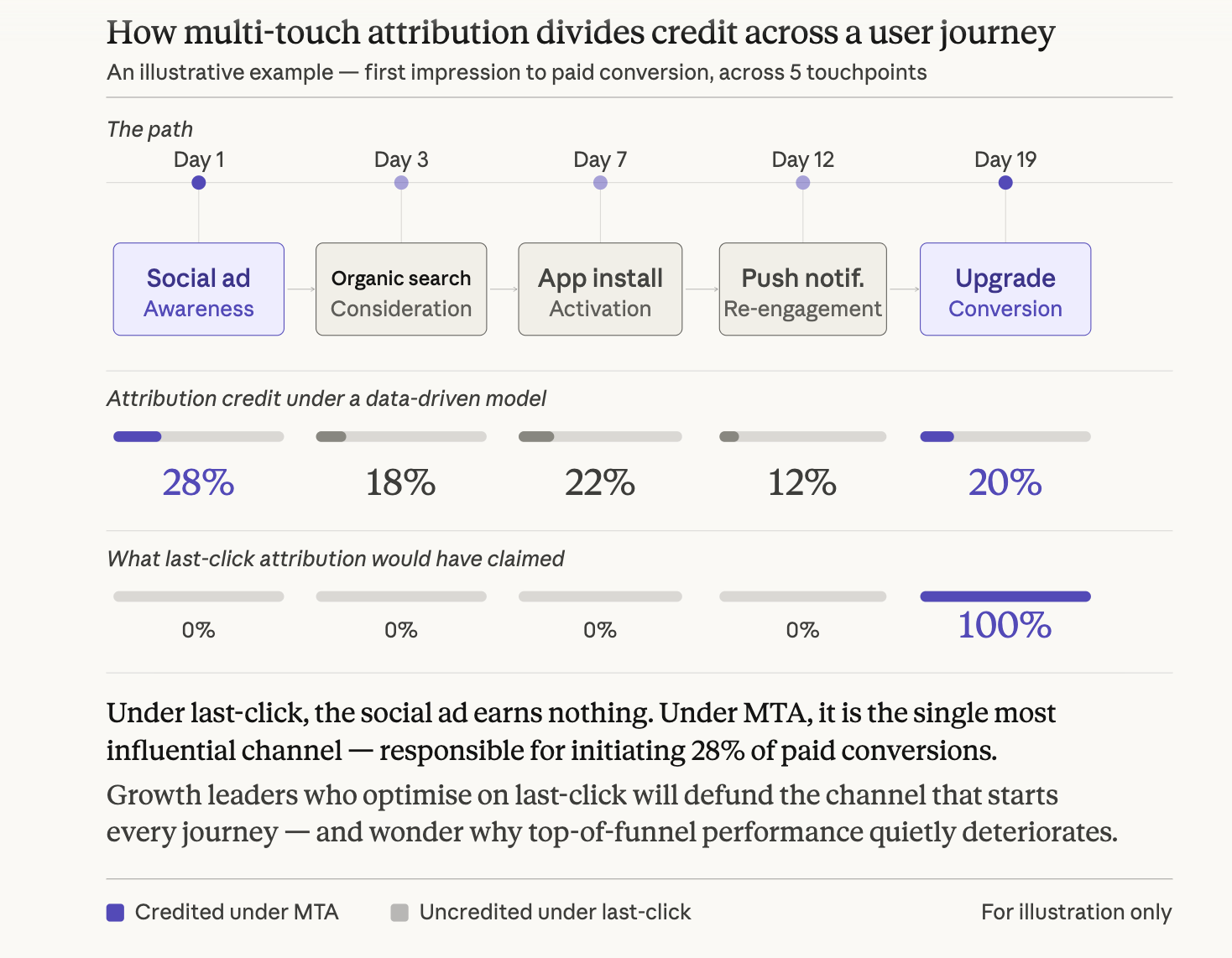
Multi-touch attribution offers a granular, real-time view of the entire customer journey. It turns marketing analytics from a scattered collection of isolated dashboards into a unified, growth system.
Implementing multi-touch attribution successfully is highly dependent on the infrastructure and decisions you make beforehand. It’s crucial to make the right choices or else you might produce a model that merely delivers an expensive, flawed picture you had not yet corrected.
Identifying whether your vertical is suitable for MTA is the first step. Generally speaking, multi-touch attribution is best-suited for industries with high transaction volume, multiple measurable touchpoints, and digital-first acquisition.
Before opting for a specific model, identify your attribution blind spots through rigorous audits. That could mean channels, operating systems (where privacy restrictions may exist), or markets where signal losses may occur and produce unreliable data insights.
Start defining the in-app conversion events that correspond to real growth targets such as first purchases and subscription activations. Slowly build your framework around all key events, not just installs. Focusing primarily on the latter could lead to undervaluing user quality and campaigns that are driving real impact.
Invest in log-in based tracking, in-app engagement signals, and direct user relationships. This is crucial now that privacy frameworks are shifting, and rewarding teams that own their data over those that rely on third-party sources.
Run incrementality tests to determine the true lift from your spend to avoid residual over-crediting from ads. This is crucial for app teams running campaigns across adjacent channels such as CTV or influencer platforms where tracking signals are partial at best.
Monitor your multi-touch attribution setup to track channels that show the highest conversion potential (where compounding growth happens), so you can reallocate spend towards them.

Many app marketers know which channels drive the highest volume of installs. But few know which of their channels actually drive the most valuable users, and this is the gap where growth stalls. However, multi-touch attribution can close that gap by shifting your optimization focus from volume to value.
Start optimizing for sticky users, the ones who stay, engage, and convert. That means looking beyond the cheapest users and discovering the ones that will deliver the most value. Since MTA frameworks bridge TOFU and BOFU touchpoints, your goal should be to uncover the full extent of your channel performance.
Showcase how initiatives like a TikTok awareness campaign or influencer marketing collaboration initiated a user journey that culminated into conversions via paid or app store search. This helps to prove that brand and awareness spend is translatable to lower-funnel activities.
Prioritize LTV measurement to reveal which channels produce users with the highest retention, deepest engagement, and strongest revenue contribution over a specified period. This is far more effective than measuring CPI, which doesn’t distinguish between high-volume, low-retention users versus high-value, low volume ones.
Show a clear, evidence-based model of how your UA spend flows through the funnel and contributes to downstream revenue. This is vital for demonstrating credibility. More importantly, providing neutral, cross-channel evidence ensures proper attribution to each touchpoint so finite budgets aren’t wasted.
At this point, the advantages of multi-touch attribution are clear. Of course, knowing how to use it effectively to make better strategic choices is where the art and science of MTA lies.
Select one MMP to provide you with comprehensive data on all user interactions. Look for features that include post-install analytics, cross-platform tracking, and deep linking. Avoid using platform-reported attribution (i.e. Meta, Google, TikTok) since they favour the platform they’re reporting on.
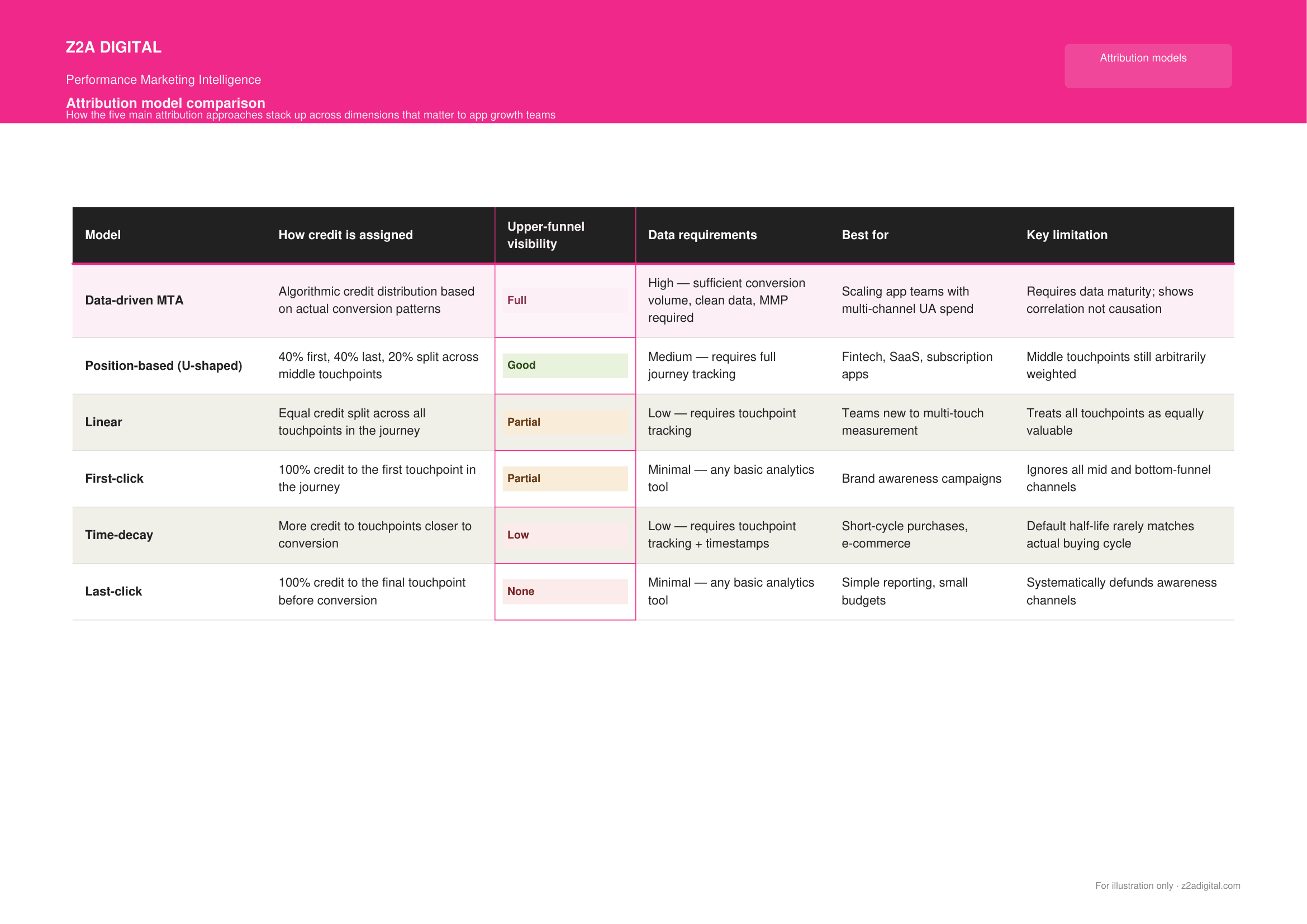
Third-party measurement allows for a neutral truth source that examines the full extent of your channels and their attribution.
Configure your MMP to track downstream events such as first purchase, subscription activations, level completions, and deposit modes. With modern MTA products, you can obtain real-time feedback across channels segmenting audiences by cohort, region, and campaign for more granular data.
Identify cohorts that show whether particular conversions are worth having, and how they’re creating long-lasting value. Doing this allows you to create realistic models of how specific cohorts spend and churn over time instead of relying on blended averages. The result is a greater ability to see downstream value within a channel and create compelling arguments to scale it.
Support your attribution efforts with geo-holdouts, A/B tests, and MMM. Combined with cohort analysis, testing for incrementality helps you understand how different user segments respond to different sequences of touchpoints.
Implement a tiered measurement stack to capture the full attribution picture since no single method provides all the details. A common stack used by modern app marketers is:
Combined, these three measurement methods triangulate your attribution, helping you to decipher conflicting signals (if present).
Guard against app install fraud as it can greatly reduce your data accuracy. Ensure your platform of choice has (ideally, privacy-compliant) capabilities to detect suspicious install patterns, click injection, and SDK spoofing. This isn’t just a nice-to-have but rather, a safety net against data degradation.
Despite the power multi-touch attribution wields for pinpointing specific events across the entire funnel, the model has some caveats. The challenges are generally structural and can have a direct impact on your attribution output, and by extension, your budgeting strategy.
Multi-touch attribution isn’t a “magic bullet” solution, but it’s one of most efficient measurement methods for app marketers today. It helps eliminate much of the data inaccuracies produced by last- and single-touchpoint models. More importantly, it gives you a holistic view of your channel performance, so you can see how upper and lower funnel events connect and reinforce each other.
That said, MTA is only as effective as the infrastructure it sits upon. That’s why it’s essential to build a solid foundation, ensuring that you set up the right parameters and safeguards to keep your data accurate. Working with an app marketing agency can help you optimize your stack, so your tracking reveals insights that help you increase your brand’s performance.
Looking to step up your data attribution to measure and optimize performance across all channels? Get in touch with us to learn how you build solid data architecture for your tracking.
Multi-touch attribution has multiple use cases. They’re especially useful when you’re measuring complex customer journeys where users interact with multiple touchpoints before making a purchase. They’re also useful for marketers looking to make precise, data-driven decisions or for analyzing competition and market changes.
Marketing mix modelling (MMM) is a method that’s best reserved for evaluating brand campaigns and understanding their long-term impact. On the other hand, multi-touch attribution (MTA) provides a deeper, more granular look into the performance of digital marketing and its various channels.
Multi-touch attribution is often seen as the most effective attribution model for marketers. It has this reputation because its purpose is to assign the right amount of value to every touchpoint or channel that users encounter. These models are often viewed as more accurate because they assign value to all points along the customer journey, not just a single transaction.

.png)



%20(3).webp)