



COMPANY
FOLLOW US


SUBSCRIBE TO OUR NEWSLETTER
RECOGNIZED BY





Attribution often breaks across multiple ad partners because each one measures its own performance and assigns credit on its own terms, for its own benefit. Fixing it comes down to consolidating credit in a single MMP and verifying the result with incrementality testing, supported by a few validation habits along the way.
The short answer to fixing unreliable attribution across several ad partners is to rely on one system instead of trusting the data each partner generates. That means consolidating credit under a single arbiter rather than trying to reconcile competing dashboards.
Also, you should align attribution windows and conversion definitions across all partners, route installs and events through one MMP that deduplicates credit, and validate postbacks and campaign naming at the source. Lastly, make sure to verify the results with incrementality testing, because deduplicated attribution merely shows who received credit, not what your ad spend actually produced.
In this post, we'll examine each of these solutions and how they can resolve the issue of unreliable attribution across multiple partners.
Create a unified setup to standardize the window and event definitions across all partners first, so any outstanding gap is an authentic measurement variance instead of a configuration artifact.
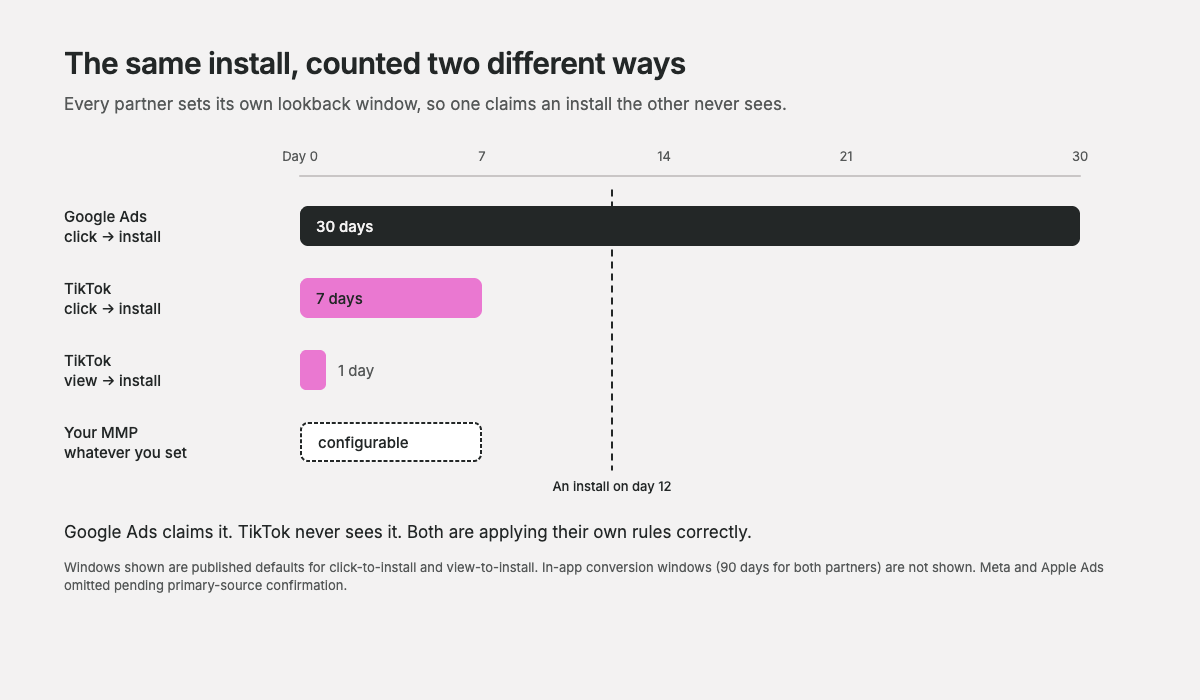
Start by collating each partner's current settings into a single view, comparing them against your MMP's configuration rather than against one another. There are substantial differences in published defaults:
Next up, fix your comparisons themselves. Misaligned reporting dates create visible anomalies even when no attribution difference is present. For example, Google reports conversions against the day of the ad interaction while the majority of third-party tools report against the day the conversion happens, meaning that comparing the same calendar period across both will create a mismatch.
Lastly, standardize what each event means. Whether it's a purchase, a signup, or a download, you need one definition that holds across every partner and your MMP. That prevents you from aligning windows around events that were never the same.
Make one MMP the sole system that assigns credit. It takes each partner's claim, applies a single attribution rule (typically last touch), and counts the install just once.

Partners can only observe their own touchpoints, so two can genuinely claim the same conversion and neither can see the overlap. Only a system outside all of them can spot it. The touchpoints that lose that comparison are logged as assists, which is why partner dashboards always show more installs than your MMP gives credit to.
On iOS, also add single-source-of-truth tooling. A privacy-preserving postback and a consented deterministic attribution can describe the same install, and reconciling them is a setup step, not a default.
Rule out the layer under your attribution model before blaming it for unreliable reports. Window calibration and deduplication both assume that underlying events are surfacing intact and defined consistently, and if they are not, no amount of downstream modeling can recover the signal. Most attribution issues don't start with the MMP.
Run geo holdout tests to determine whether your credited conversions would have occurred anyway, then triangulate instead of choosing one method. Everything above makes your numbers consistent, and consistent is not the same as accurate.
Incrementality provides an answer to the causation question by withholding media instead of modeling it. Geo holdouts suppress spend in matched markets and compare against controls, capturing cross-device and cross-platform effects no user-level system can see.
One caveat with geo tests is that they carry their own biases through market selection, seasonal variances, and narrow windows, and most run too briefly to identify brand effects. That makes triangulation crucial:
With every partner measuring its own performance, you can't just configure data discrepancies away. Attribution issues only settle once a single system outside those partners decides who gets credit.
The four fixes mentioned in this article all build toward that:
Carry out all four and the weekly dilemma of determining whose number is correct fades. Not because the numbers finally agree, but because each one has a job.
Ready to improve your measurement and attribution across multiple partners? Get in touch with us today.
Each partner measures its own performance against its own lookback window and can only observe its own touchpoints. Two partners can genuinely claim the same conversion, yet neither can spot the overlap.
None on their own. First-party data establishes revenue, your MMP establishes credit, and platform dashboards optimize delivery instead of arbitrating performance.
No, because deduplicated attribution identifies who received credit, not whether the conversion needed the ad to occur. Incrementality testing answers that second question.