For many UA departments, integration isn't the issue. Organization is.
Programmatic strategy rests with one manager. Paid social strategy sits on another manager's desk (or Google Drive folder). Each has its own budget requirements, dashboard, and definition of what success looks like. And when performance reaches a ceiling, the tendency is to ask which channel isn't working, not whether the two were ever set up to work together in the first place.
And that's the problem.
Paid social and programmatic are often treated as two channels competing for the same outcome. But they're built to accomplish different goals, at different points in the funnel, and to generate different data sets. That's why you can't treat them the same. That said, the question is how you incorporate these channels into your user acquisition strategy.
Paid social inhabits walled gardens, which is where its value lies. It abounds with behavioral and interest data on users before they even see your ads. It provides algorithmic depth and reach that finds high-intent users you can't find on your own. And it's fast, allows for cheap testing, and is where winning creative surfaces.
Programmatic operates on the opposite end of the scale. It buys audiences across the open web and app ecosystem, including display, video, audio, and CTV platforms, using real-time bidding to follow each user's trail. What it lacks in paid social's native advantages, it makes up for in precision and reach that paid social simply can't match.
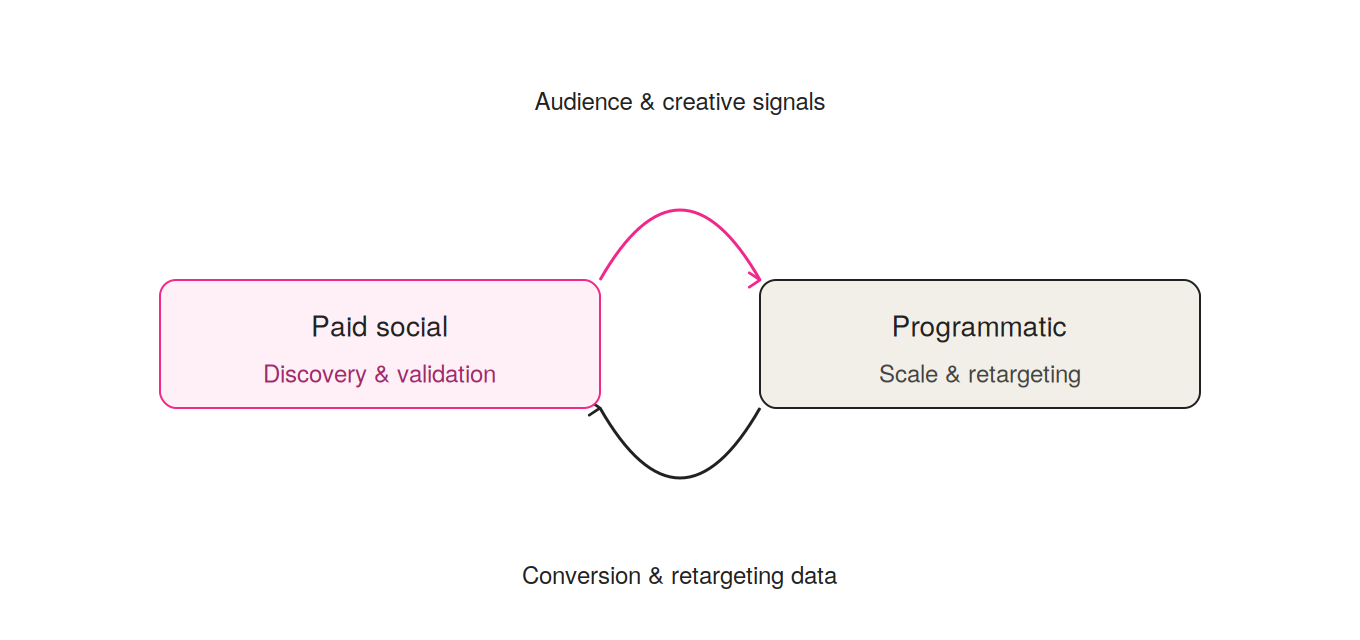
That said, neither channel is better. Paid social offers discovery and validation. Programmatic offers scale and retargeting. A sound UA strategy recognizes their strengths and incorporates them where they belong.
It's important to see them under this lens because it goes against the grain for many agencies. Conversations around budget often go something like: "should we shift spend from paid social to programmatic this quarter?"
But instead the question should be: "How do you allocate spend across these channels?" or "What did our paid social efforts learn that programmatic hasn't discovered yet, and what is programmatic seeing at scale that should influence our social targeting?"
The key to success in leveraging both channels isn't running them simultaneously, but rather building a loop between them, since each channel provides distinct advantages that reinforce each other and fill in the gaps left by their counterparts.
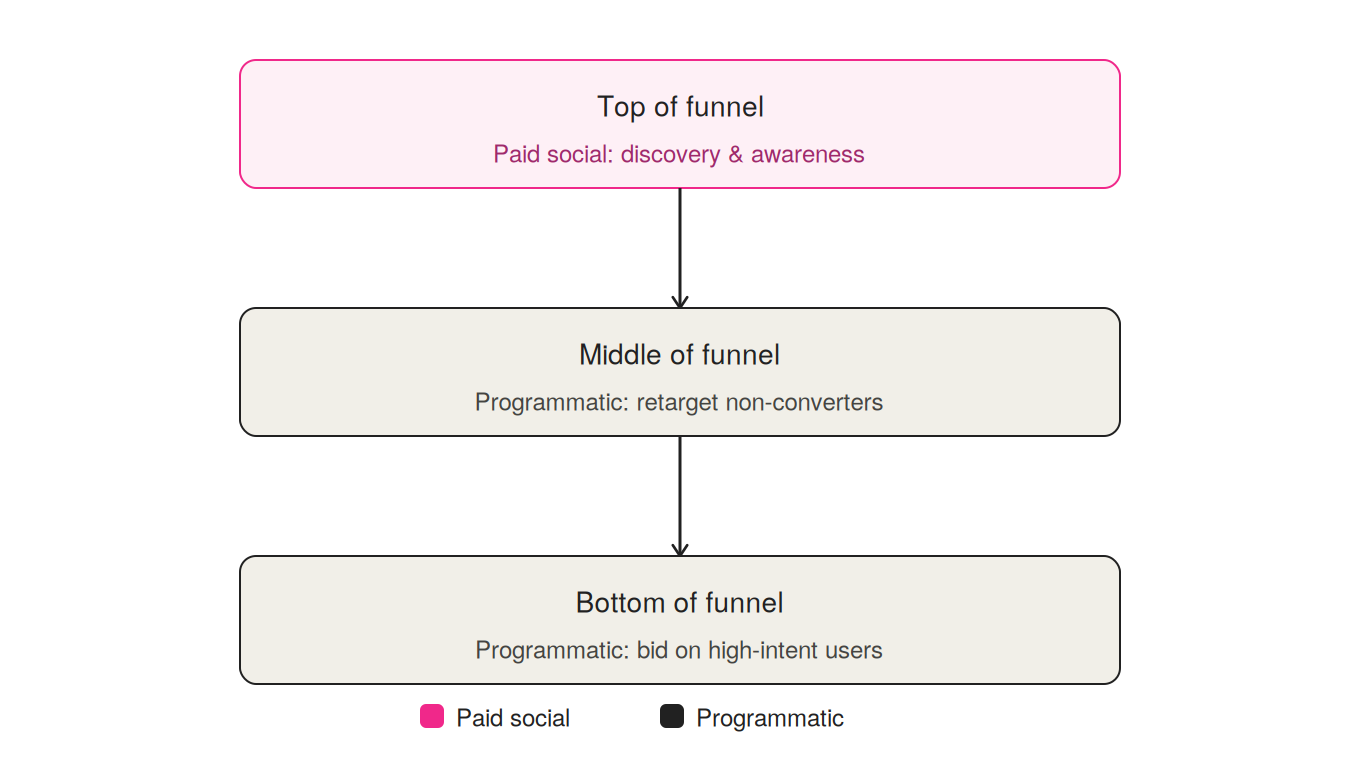
Once you've established your signal loop, the next step is to assign roles for each funnel stage. This ensures that both your paid social and programmatic channels are doing their jobs where and how they shine best.
Top-of-the-Funnel: This is where paid social works best. The channel offers a high level of opportunity for discovery, awareness-driven campaigns, native ads, and algorithmic penetration into audiences you haven't yet defined. Ultimately, you're paying to learn what works.
Middle-of-the-Funnel: This is the stage where programmatic enters the picture. If a user sees your social ad but doesn't convert, they need to be rediscovered. This rediscovery may happen on websites, in apps, or even on streaming platforms. Regardless of where, programmatic allows you to retarget these audiences at scale across various platforms.
Bottom-of-the-Funnel: This is the stage where programmatic's full power comes into focus. At this point, you'll know who your high-intent segments are thanks to the insights given to you by your paid social efforts. Real-time bidding lets you hone in precisely on users instead of making broad buys (and crossing your fingers).
With these roles assigned for each funnel stage, you now have the foundation for a loop strategy that will balance your user acquisition.
No matter how tight your funnel and loop sequencing is, the strategy falls apart if your measurement and attribution aren't strong. This is especially true in the modern post-IDFA and Privacy Sandbox era. Not only do you need robust attribution signals, but you need the right ones, capturing the data points that actually matter.
For example, last-click attribution often undercounts programmatic. A user gets served a programmatic ad, doesn't click, sees a social ad a couple of days later, and then converts. Due to the nature of last-click attribution, all credit goes to paid social. Programmatic did the real work here.
Ideally, you'll have a good MMP that unifies install, open, and downstream conversion metrics back to the campaigns that actually touched the user, instead of merely crediting the last touchpoint. If you don't have that infrastructure in place, you're measuring recency bias, not actual channel performance.
What do you need?
One of the best ways to fix this attribution problem when aligning paid social and programmatic is to run incrementality tests. That includes running holdouts to see what conversions actually wouldn't have occurred without a given channel, rather than taking a platform's self-reported data at face value.
A holdout test acts as an impartial mediator of sorts, giving you precise attribution and credit regarding which platform accomplished what.
Practical tips to make these tests more usable:
Creating the user acquisition reinforcement that comes with programmatic and paid social looping can feel like a major strategic overhaul. And that could mean not knowing exactly where to start. However, a couple of pointers can put you in the right direction so you can implement it correctly.
With this implementation sequence, you can create a roadmap that makes building a programmatic and paid social loop more manageable to execute. And in due time, you'll be able to build a streamlined system where both channels inform each other, creating a synergy that ramps up your user acquisition efforts.
Are you looking for a growth partner that can leverage programmatic and paid social channels to boost your user acquisition? Get in touch with us to learn how we can tie these channels together and drive profitable growth.
A key disadvantage of programmatic advertising is its risk to brand safety and placement transparency. Since buying ad inventory is automated via real-time bidding and algorithms, your ads may appear next to inappropriate or controversial content, which may tarnish your brand’s reputation.
Paid social media advertising is the practice where marketers and brands pay platforms (i.e, Meta, TikTok, Google) to display promotional content to highly targeted audiences. Unlike organic (free) posts, paid ads are guaranteed to be seen by users, offering brands the ability to scale reach, drive traffic, and generate leads fast.
The biggest programmatic demand-side platforms (DSPs) include Amazon DSP, Google’s Display & Video 360 (DV360), and The Trade Desk. Google and Amazon are dominant through proprietary “walled gardens”, but The Trade Desk is the largest independent DSP, focusing on open internet and Connected TV (CTV) advertising opportunities.

.png)
%20(3).webp)